Starbucks Barista Training: Your First 30 Days Explained
Quick Answer: Starbucks barista training is a paid onboarding program that Starbucks calls Barista First 30, covering essential skills in your first month with follow up training at 90 and 190 days. New partners mix short digital learning modules with guided shifts on the bar next to a Barista Trainer, then move onto the floor once their store manager signs off. Most new hires report spending about two to four weeks in active training, though the exact schedule depends on your store. Since 2025, training also covers Green Apron Service, the company’s new hospitality and service model.
- Training time is scheduled like regular shifts and paid at your normal hourly rate.
- Your trainer is a fellow barista in the Barista Trainer role, not a manager or a corporate instructor.
- The current program puts as much weight on greeting customers and recovering from mistakes as on drink recipes.
- Learning keeps going after week one, with check ins at roughly the three month and six month marks.
- Memorizing a handful of standard patterns beats trying to memorize the whole menu.
What Is the Starbucks Training Program?
The Starbucks training program is the structured onboarding every new barista completes before working the floor alone. Starbucks describes it officially as Barista First 30: essential training in your first month, plus additional training at 90 and 190 days.
What this means for you is that training comes in layers. The first month makes you safe, useful, and accurate on a shift; the later touchpoints build depth once you have real shifts behind you.
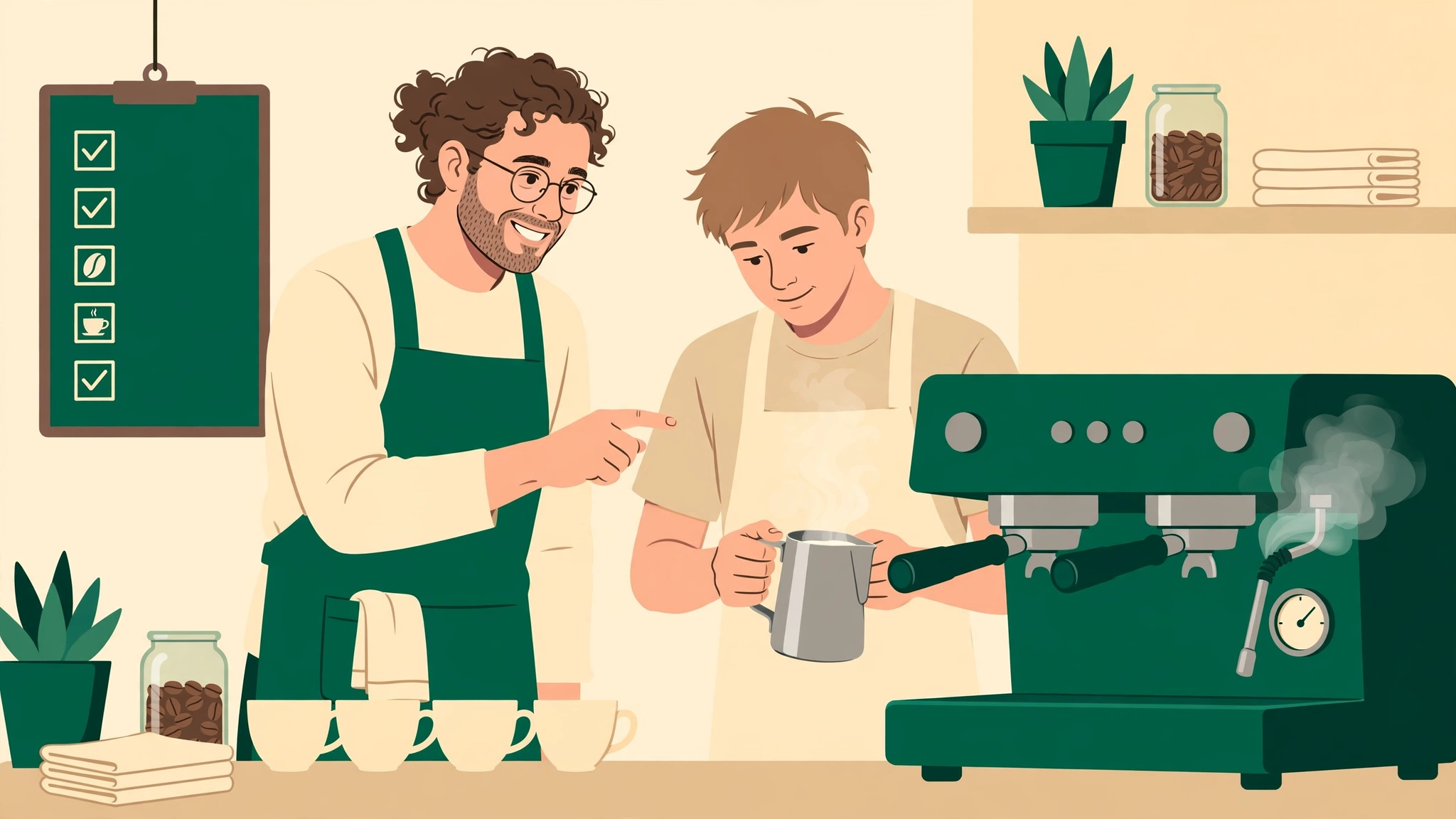
Most partners describe the content in “learning blocks.” Each block pairs a short digital module with time on the bar, where your trainer shows you a skill, lets you try it, then watches you repeat it alone. Your store manager typically checks your progress partway through.
The reason for this format is simple. A video about steaming milk teaches you very little, while a trainer correcting the angle of your wand teaches you in minutes. Think of this article as your Starbucks barista training guide for getting through each layer.
What Happens on Your Starbucks First Day of Training?
Your Starbucks first day of training is usually a short shift focused on orientation, not drink making. Expect paperwork, a store tour, meeting your team, and your first digital modules, often finished with a coffee tasting.
Most first shifts run a few hours. You will learn where things live, get your apron, and set up your partner accounts. A tasting is a common opener because it quickly explains why Starbucks cares about roast profiles and freshness.
Before day one, read the Starbucks dress code policy and set up the Starbucks Partner Hours app so you can see future training shifts.
What most articles miss is that nobody expects a correct drink from you on day one. Absorb the layout and ask questions; confidence comes later.
How Long Is Starbucks Barista Training?
Most new baristas spend about two to four weeks in active training before working regular shifts without a trainer beside them. Starbucks frames the full program around your first 30 days, with refreshers later in your first year.
The length depends on how many hours you are scheduled, how busy your store is, and how quickly you pass your trainer’s observations. Someone working 25 hours a week usually finishes faster than someone working 12.
Starbucks Training Hours and Schedule
Starbucks training hours are scheduled into your normal weekly schedule and paid like any other shift. There is no separate unpaid course to finish at home.
Here is a typical Starbucks barista training plan, based on how partners describe their first month. Every store adapts it, so treat it as a guide rather than an official calendar.
| Stage | Typical Timing | What You Focus On |
|---|---|---|
| Orientation | Day 1 | Paperwork, store tour, apron, coffee tasting, first modules |
| Foundations | Week 1 | Food safety, cleaning routines, brewed coffee, register and customer support |
| Bar basics | Weeks 1 to 2 | Espresso shots, milk steaming, hot and iced drink patterns |
| Advanced drinks | Weeks 2 to 3 | Frappuccino blended drinks, cold foam, drive thru and mobile orders |
| Floor readiness | Weeks 3 to 4 | Working positions during real rushes with lighter support |
| Follow up | Around 90 and 190 days | Deeper skills, coaching, and refreshers |
Many managers put new partners on calmer dayparts first so the trainer can actually teach. You can always check your schedule to see which shifts are marked as training.
What Is the Starbucks New Training Program?
The Starbucks new training program centers on Green Apron Service, a service and staffing model the company began training baristas on in July 2025. It focuses on warmer customer connection, faster service, and clearer roles during busy periods.
It grew out of CEO Brian Niccol’s “Back to Starbucks” strategy. According to CNBC, a pilot across 1,500 stores showed better transactions, sales, and service times, with 80% of in cafe orders hitting the chain’s four minute goal. Starbucks also committed more than $500 million in labor hours to support the rollout.
For a new barista, the changes show up in a few concrete ways:
- Connection habits. Training materials reviewed by The Wall Street Journal tell baristas to pause and make eye contact rather than rushing the moment.
- The L.A.T.T.E. method. When something goes wrong, you Listen, Apologize, Take action, Thank, and Ensure satisfaction.
- Speed goals. Training documents reported by Bloomberg set a goal of about four minutes for in store and drive thru orders, and around 12 minutes for mobile and delivery orders.
- Clearer roles at peak. A Peak Play Caller helps direct baristas during rushes, so you are not guessing where to jump in.
In practice, training now treats hospitality as a learnable skill, not a personality trait.
Who Is a Starbucks Barista Trainer?
A Starbucks barista trainer is an experienced barista chosen to teach new partners on the floor. They demonstrate each skill, let you practice, observe you, and report your progress to the store manager.
Trainers stay hourly while taking on teaching duties. The best ones can explain why a step matters and still keep the line moving. If you enjoy training others, this role is a common first step toward shift supervisor. Starbucks has also created a full time coffeehouse coach role between shift supervisor and store manager, and says it aims to promote 90% of retail leaders from within.
Starbucks Barista Training Cheat Sheet
The fastest way to learn the bar is to memorize patterns, not individual drinks. Most handcrafted beverages follow the same small set of rules for shots, syrup, and milk.
These are long standing defaults for standard espresso drinks. Recipes change, so confirm against your store’s current recipe cards.
| Size | Espresso Shots (hot) | Syrup Pumps (hot) | Syrup Pumps (iced) |
|---|---|---|---|
| Short | 1 | 2 | Not offered |
| Tall | 1 | 3 | 3 |
| Grande | 2 | 4 | 4 |
| Venti | 2 | 5 | 6 |
A few more rules worth writing on a sticky note:
- Venti iced espresso drinks get 3 shots, which is why they get the extra pump of syrup too.
- Read labels in order. Labels follow the classic cup sequence: decaf, shots, syrup, milk, customizations, then the drink itself.
- Start milk before shots. Steaming takes longer than pulling espresso, so starting milk first keeps shots from sitting.
Most people discover that once these patterns click, the rest of the menu is just variations on the same building blocks.
Common Mistakes New Baristas Make in Training
Most struggles come from trying to learn everything at once. Avoid memorizing the whole menu, since patterns plus your store’s top sellers cover nearly every shift. Ask “why” whenever you feel lost, because understanding a step makes it stick. Put accuracy before speed. And never rush the digital modules, which cover food safety and allergen rules that protect customers and your job.
The Honest Limitation of Starbucks Training
Because skills pass from partner to partner, training quality can vary between stores and trainers.
A short staffed store may push new hires onto the floor faster than planned, and some partners say they felt rushed after a week and a half. If that happens, ask your manager for more training shifts. It also helps to review the Starbucks break policy so you know when you are entitled to rest.
How Training Connects to Pay and Benefits
Training shifts count toward your hours, so they also count toward benefits eligibility. Starbucks offers its benefits package to partners averaging at least 20 hours a week.
Benefits like the Starbucks College Achievement Plan, which covers tuition for an online bachelor’s degree through Arizona State University, depend on that threshold. Starbucks says its total compensation and benefits package is worth an average of $30 per hour for hourly roles. You can explore the full list in this guide to Starbucks benefits.
For the official picture, read Starbucks’ own Training and Mentorship overview, its 2026 announcement on new rewards for hourly partners, and NBC News coverage of the Green Apron Service strategy.
Frequently Asked Questions
Do you get paid for Starbucks training?
Yes. Starbucks schedules training like regular shifts and pays it at your standard hourly rate. Training hours also count toward your weekly total for benefits eligibility.
Can you fail Starbucks barista training?
Training is not a pass or fail test. Your trainer observes your skills and your manager signs off when you are ready. If you need more time, the usual fix is extra training shifts rather than being let go.
Do trainees get tips at Starbucks?
Generally yes. Starbucks distributes tips based on hours worked on the days the tips came in, and paid training hours are hours worked.
Is Starbucks training hard?
Most new partners find it manageable but busy. The hardest part is the volume of drink patterns early on, which eases once the standard shot and syrup rules click.
How many hours a day is Starbucks training?
Training shifts usually match the normal shift lengths at your store. Your first orientation shift is commonly shorter, often just two to four hours.
What should I wear to my first Starbucks training shift?
Since the 2025 dress code update, partners wear a solid black shirt with khaki, black, or blue denim bottoms, plus closed toe shoes in a dark neutral color. Your store provides the green apron.
Do you learn latte art in Starbucks training?
Basic milk texturing is part of bar training. Detailed latte art is more of an advanced skill, often practiced later or by trainers who must demonstrate it.
What is Barista First 30?
Barista First 30 is Starbucks’ name for its first month onboarding program. It covers essential skills in your first 30 days, followed by more training at 90 and 190 days.
What is the L.A.T.T.E. method at Starbucks?
L.A.T.T.E. is a service recovery framework taught to baristas: Listen, Apologize, Take action, Thank, and Ensure satisfaction. It guides how you respond when an order goes wrong.
How do you become a Starbucks barista trainer?
Most trainers are experienced baristas selected by their store manager. Strong drink skills, patience, and clear communication matter more than tenure alone.
What is the Starbucks Coffee Master program?
The Coffee Master program is an advanced coffee education track for partners. Those who complete it earn the black apron, the most visible learning credential at Starbucks.
What if I miss a training shift?
Tell your manager early and follow your store’s call out procedure. The shift is usually rescheduled, though repeated absences slow your progress.
Conclusion
Starbucks barista training works best when you treat it as a month of guided repetition rather than a test. Take the service habits as seriously as the recipes, and lean on your trainer. Before your next shift, save the cheat sheet table to your phone, look over your upcoming training schedule, and walk in ready to learn. The bar will feel familiar sooner than you expect.

Oliver Charlotte researches and writes Starsbuckspartnerhours independent guides to Starbucks partner hours, schedules, pay, and policies. Oliver builds each guide from Starbucks sources, and partner reports, and each one is reviewed by a current or former partner.